The day before December..followed by ….December…Brrr!


The day before December..followed by ….December…Brrr!
Well it has been…honestly! Before Storm Angus and contrary to my misty photographs, we have been down to shirt sleeves most days since starting Mr and Mrs G’s wheat reed re-thatch. Although it’s a little bit different from the quiet rural idyll of our last job: it takes ages to cross the road to the van, which has had it’s mirror knocked off twice this week; we have to shout to be heard over the noise of the traffic and we have to be super careful not to drop the bales of old reed on top of passers by….on the up side; Mr and Mrs G. are looking after us beautifully, with bacon sandwiches and fruit cake, the butcher has bones for Stitch the dog and we have the museum next door (http://www.chardmuseum.co.uk/History_of_Chard/) where we learned that Chard is the birth place of powered flight….sorry about that Dayton!


This being a wheat reed roof with a block ridge, it has a nice rythm to the working of it. You have to handle wheat reed to get it to lie right, working each armful to sort and tidy and tap down the stems. Order from chaos, each armful dressed and bound with a few twisted stems from it’s neighbour. Happy.
We recently re-ridged this lovely cottage in Rawridge for Maggie….


…and this is what she said when we finished:


A well thatched porch can add real interest and character to your home. Here you can see the before, during and after of a couple we have done recently…


Whilst Ivy and other climbing plants form a superb habitat for wildlife throughout the year, and do much to soften the divide between buildings and landscape; they are a costly nuisance to thatched roofs. Also close growing shrubs and small trees, whose young branches will tousle their way through the thatch when the wind is up, leaving a hollow which will slow and gather the rain. A hollow on a roof gathering water will be a weak point, subject to rotting and wearing faster than the rest of the coat work.
Below you can see how the ivy has grown over and into this roof. Removing the ivy must be done with care, teasing out each piece, while keeping pressure on the roof above. The third picture shows what happens if removing the ivy is done with too much enthusiasm…..it will take large parts of the thatch with it!


We cleared the ivy back to about 2 feet from the building and pruned the overhanging branches of the tree back too. Having tidied up the large hole left by someone else’s vigorous endeavours in ivy removal, we could patch from the eaves up, keeping the building dry until it’s re-thatch next year.


It is vital to manage all growth near to your thatched roof, in order to keep it in best condition. Ivy is best pruned back during the Autumn and Winter so as not to disturb the wildlife within it.
So we have thatched our way almost to the water table at the gable end, the weakest point in the old coatwork…by a long way. As we stripped off the top layer, looking for the timbers beneath, it became apparent that they were long gone. Any timber left was rotten as a pear, and broken away from the main roof structure.


The pictures above show the absence of timbers over the chimney breast and a marvellous pile of compost, which we replaced with a timber ladder to carry the thatch and give us something to fix to. The last photo is of the replacement roof structure a step down from the chimney breast. Finally where we normally have the layers and layers of old coatwork to fix into, we now have to replace it to bring the depth of thatch up in the same plane as the rest of the roof….effectivly thatching it 3 times in the same spot!


So now for our final coat. We did just point in around the gable where the mortar had rotted out over the years…


Just the ridge to go, the eaves to cut out and the coat to sweep and dress…on my own again as the apprentice is off on holiday…sigh!
So we got as far as the chimney realising that it needed raking out and re-pointing in parts as the old mortar had deteriorated and fallen away. There are various possible causes, but in this case it was the result of Mortar bees tunnelling through the lime and nesting; the water can then get in, freezes and cracks out the mortar. Not to do this work now could mean either that the repair is overlooked and then the chimney becomes unstable, or at the very least, our lovely new thatch could end up damaged with foot prints and so on.


Where clients have their own builders, we are happy to work with them, but in this case, the builder was unable to break away from his other work, so Alan re-pointed the chimney before continuing to thatch around it. We finished by stripping the next section, and again fitting tiles beneath the eaves…ready to start again Monday.


Stitch the dog, meanwhile, decided to test the insulating properties of reed…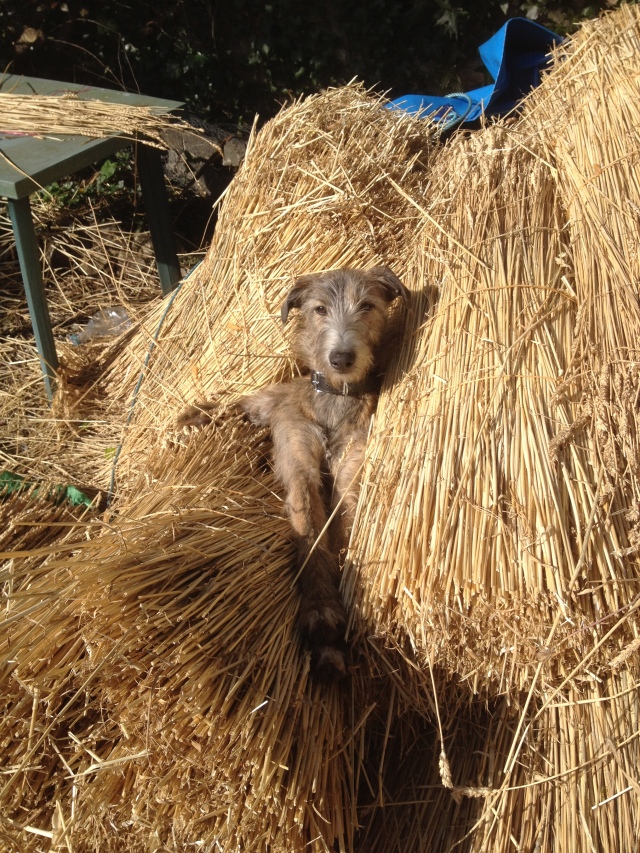
Sometimes the thatch needs to be disturbed in order to exit vents, or wiring and pipework. This week in Tatworth as we swept around the valley we came to the central heating vent. This had been well fitted with no damage to the old coatwork, however it would have been impossible for the builder to fit a sub-frame beneath the flashing with the old coatwork in place. Now that we have revealed the eaves we can remedy this:


Fitting slates around the vent will support the flashing and prevent it from sagging and allowing water to pool.


So now the flashing and vent can be returned to their place. We also added a course of slates along the whole eave where the slate roof meets the thatch. This forms a better overlap beneath the eaves of the thatch as some of the slates had cracked or broken. Finally we can tie in our eaves wads using the new batten where the old has become brittle or broken.


…this week we love….the lovely Mrs A. and her bacon sandwiches; the sunshine, the apprentice’s return to work after a month studying other things.
We do not like so much…not being able to find anything after the apprentice’s return to work…harrumph.
Being a well established business for 18 years, providing an efficient, reliable and professional service at competitive prices, offering a nationwide service from listed properties to new builds. We are able to adapt to regional styles where we work and cooperate with local conservation officers. Smaller commissions included thatching of tree houses, sun rooms and garden follys.
We carry out complete thatch, re-ridging of existing thatch, thatching repairs, chimney re-build and pointing, roof timber work and insurance work. Working with Combed Wheat Reed and Water Reed with handmade spars and gads. Locally sourced materials are used whenever possible. Qualified skilled craftsmen such as carpenters, joiners, cob wall builders can be arranged as part of our complete service. Scaffolding is carefully supervised to protect climbing plants, threading the poles through where necessary and ensuring ladders do not crush flower beds.


 Ferrari the Thatcher